





Why Businesses in Azerbaijan Are Migrating from HDD to NVMe Enterprise SSD
Why Businesses in Azerbaijan Are Migrating from HDD to NVMe Enterprise SSD
Modern server infrastructure demands high speed, minimal latency, and reliable data protection. That is why companies in Baku and across Azerbaijan are increasingly upgrading Dell PowerEdge, HPE ProLiant, and Lenovo ThinkSystem servers, moving from HDD and SATA SSD to Samsung NVMe Enterprise SSD.
Introduction: Why Traditional HDDs Are No Longer Enough
A few years ago, most enterprise servers were built on SAS and SATA drives. These solutions remain viable for archival storage, backups, and less critical tasks, but modern business applications require a different level of performance.
Virtualization, databases, ERP systems, CRM, file services, video surveillance, backups, analytics, and cloud services continuously load the storage system.
NVMe as the New Standard of Enterprise Infrastructure
NVMe, or Non-Volatile Memory Express, is a modern protocol designed specifically for solid-state drives operating over high-speed PCI Express lanes.
Why NVMe Matters for Business
- Fast booting of virtual machines and server applications.
- Stable database performance under heavy load.
- Accelerated backup and data recovery processes.
- Higher density of virtual machines per server.
- Reduced latency in VMware, Microsoft Hyper-V, and Proxmox.
- More efficient use of server CPU and memory resources.
| Parameter | HDD | SATA SSD | NVMe Enterprise SSD |
|---|---|---|---|
| Interface | SATA / SAS | SATA | PCIe NVMe |
| Typical Read Speed | 150–250 MB/s | up to 560 MB/s | up to 6,800 MB/s for PCIe Gen4 and up to 14,000 MB/s for PCIe Gen5 |
| Latency | High | Low | Minimal |
| Best Scenarios | Archives, cold data | Basic server tasks | Virtualization, databases, cloud services, data centers |
Samsung PM9A3: A Versatile NVMe SSD for Modern Servers
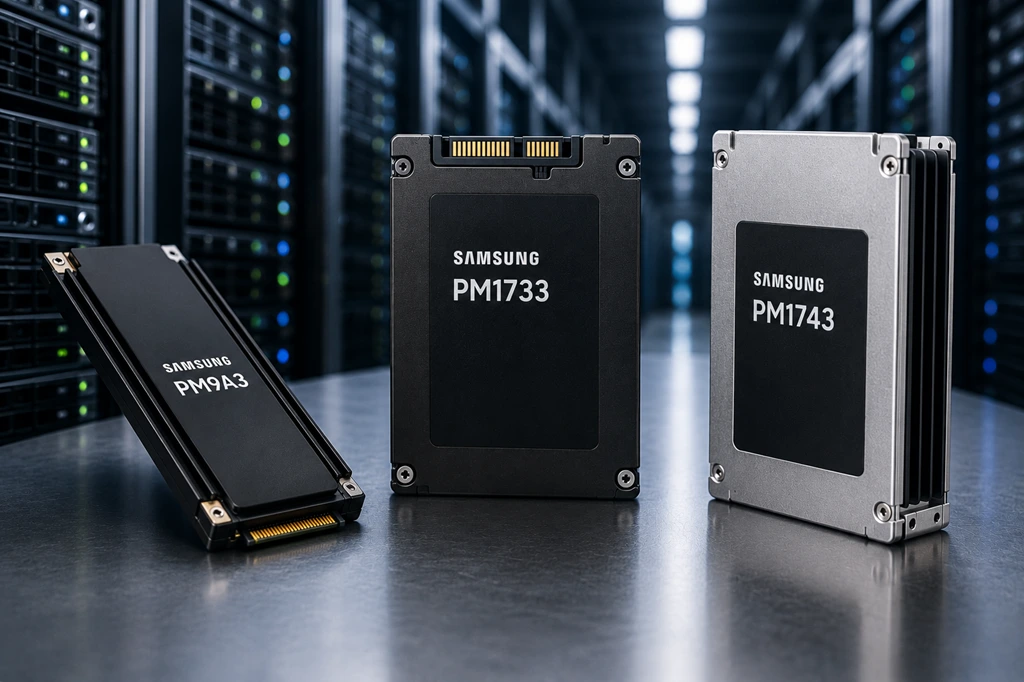
Samsung PM9A3 is one of the most practical options for companies looking to move to NVMe without excessive costs. This model belongs to the Data Center SSD class and is well-suited for servers, virtualization, enterprise applications, and cloud services.
PM9A3 uses PCIe Gen4 interface and is available in several form factors, including U.2, M.2, and E1.S.
| Specification | Samsung PM9A3 |
|---|---|
| Interface | PCIe Gen4 NVMe |
| Sequential Read Speed | up to 6,800 MB/s |
| Form Factors | U.2, M.2, E1.S |
| Use Case | Data centers, servers, virtualization, enterprise applications |
| Key Benefits | Energy efficiency, scalability, high speed, enterprise-grade data protection |
Samsung PM1733 and PM1743: Solutions for High-Load Systems
Samsung PM1733
Samsung PM1733 is an enterprise NVMe SSD based on PCIe Gen4, designed for high-load server scenarios. It is suitable for data centers, all-flash systems, virtualization, databases, and infrastructures where stable performance and fault tolerance are critical.
Samsung PM1743
Samsung PM1743 is a newer generation of Samsung enterprise SSDs with PCIe Gen5 interface. This model targets high-performance servers, data centers, AI workloads, analytical platforms, and mission-critical enterprise applications.
| Model | Interface | Main Use Case | Ideal For |
|---|---|---|---|
| Samsung PM1733 | PCIe Gen4 NVMe | High-load servers, virtualization, all-flash storage | Companies needing reliable Gen4 performance |
| Samsung PM1743 | PCIe Gen5 NVMe | Data centers, AI, databases, modern server platforms | Organizations building next-generation infrastructure |
Areas of Application for Enterprise NVMe SSD
Migrating to NVMe Enterprise SSD is especially relevant for businesses where storage system performance directly affects business speed.
Virtualization
VMware vSphere, Microsoft Hyper-V, and Proxmox show noticeable speed improvements with NVMe SSDs.
Databases
Microsoft SQL Server, PostgreSQL, Oracle, and MySQL handle transactions and queries faster.
File Services
User access to documents, projects, archives, and shared network resources is accelerated.
Backup
Backup windows are shortened, and recovery after failures is faster.
ERP and CRM
Enterprise systems operate more stably with a large number of users.
Data Centers
Storage density increases, latency is reduced, and overall infrastructure efficiency improves.
What This Means for Business in Azerbaijan
For companies in Azerbaijan, upgrading the server storage subsystem is a practical step that can yield quick results without a complete overhaul of the entire IT infrastructure.
Banks, logistics companies, industrial enterprises, medical organizations, government institutions, educational institutions, and private businesses face growing data volumes.
- Dell PowerEdge, HPE ProLiant, and Lenovo ThinkSystem servers run faster.
- Downtime during maintenance and data recovery is reduced.
- Virtual machine performance increases.
- Enterprise databases and business applications run faster.
- Load on legacy disk arrays is reduced.
- IT infrastructure becomes ready for new demands, including AI and analytics.
How to Choose the Right Samsung Enterprise SSD
| Task | Recommended Model | Reason |
|---|---|---|
| Upgrading an existing server | Samsung PM9A3 | Optimal balance of speed, cost, and compatibility |
| High-load virtualization | Samsung PM1733 | Stable Gen4 performance for enterprise workloads |
| New PCIe Gen5 servers | Samsung PM1743 | Maximum performance for modern data centers |
| Databases and analytics | PM1733 / PM1743 | High read speeds and low latency |
Need to Upgrade Your Server Infrastructure?
RealTech helps select server SSDs, storage systems, network equipment, and solutions for enterprise infrastructure in Azerbaijan. We can assist in selecting compatible drives for Dell PowerEdge, HPE ProLiant, Lenovo ThinkSystem, VMware, Hyper-V, and Proxmox.
Contact RealTech